Home / Guides / Markup vs margin: why the price comes out differently
Markup vs margin: why the price comes out differently
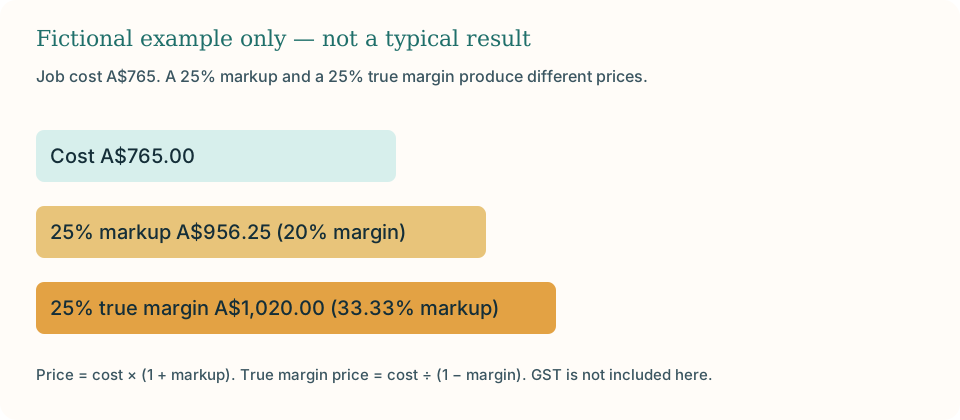
Markup and margin both start from cost, but they answer different questions. If you treat a 25% markup as a 25% margin, the selling price comes out lower than you meant. This guide shows the two formulas with a fictional Australian dollar example. It is planning maths, not a claim about what you will earn.
The short version
Markup is the percentage you add on top of cost. Margin is the percentage of the selling price that is left after cost. They only match at 0%. As soon as the percentage is above zero, a 25% markup and a 25% margin produce two different prices.
- Markup price = cost × (1 + markup). A 25% markup on A$765 is A$765 × 1.25 = A$956.25.
- True margin price = cost ÷ (1 − margin). A 25% margin on A$765 is A$765 ÷ 0.75 = A$1,020.00.
That A$1,020 price is a 33.33% markup on the same cost, because A$255 ÷ A$765 = 0.3333. The A$956.25 markup price is only a 20% margin, because A$191.25 ÷ A$956.25 = 0.20.
Why this trips people up
In conversation, “I want 25% on top” can mean either idea. One person is thinking “add a quarter of the cost.” Another is thinking “I want a quarter of the invoice to be surplus after cost.” Both are valid aims. They are not the same number. If your quote is built on the wrong one, you can send a price that does not match the surplus you had in mind.
This matters more as the percentage rises. At 10%, the two prices are close. At 25%, the gap on A$765 is A$63.75. At 40%, a markup price is cost × 1.40, while a margin price is cost ÷ 0.60, which is much higher. The higher the target, the more the formulas diverge.
A worked example, labelled fictional
The numbers below match the sample used on the homepage calculator. They are a teaching example, not a typical tradie job and not a forecast.
- Job cost: A$765, made up of labour at a recovery rate, materials, and other direct costs.
- 25% markup selling price, before GST: A$956.25. Surplus: A$191.25.
- 25% true margin selling price, before GST: A$1,020.00. Surplus: A$255.00.
If you already have a price in mind, you can work backwards. Margin = (price − cost) ÷ price. Markup = (price − cost) ÷ cost. Use the same dollars in both, and do not mix a GST-inclusive price with a GST-exclusive cost unless you mean to.
Where GST fits
The comparison above is before GST. Goods and services tax, if it applies to your sale, is a separate question from markup and margin. If you add 10% GST after you have set a GST-exclusive price, you are not increasing your margin by 10%. You are collecting an amount that a GST-registered business generally remits through its activity statements, subject to credits it can claim. See the GST on quotes basics guide and the ATO, not this page, for whether you should be registered.
How to choose which one you meant
If your goal is “add a set percentage on top of what this job cost me,” you are describing markup. If your goal is “after I recover cost, I want a set share of the price left over,” you are describing true margin. Many quoting spreadsheets, including the Aussie Sole Trader pack, use true margin: price = cost ÷ (1 − margin). That makes the surplus a chosen fraction of the quote, before GST.
Neither formula decides whether the price is fair, whether a client will accept it, or whether the job is worth taking. They only translate a cost and a percentage into a number you can write on a quote.
Try the sums without buying anything
The homepage has a free markup vs margin calculator that runs in your browser. It is not sent or saved. You can enter the fictional A$765 sample, or your own cost, and switch between true margin, markup, and a price you already have. There is also a free preview PDF that shows how the paid workbook is laid out.
If you want the same logic in a quote sheet you can reuse, the Quote & Break-Even Pack applies one target margin after it has costed the job. It does not guarantee work, income, or a particular result.
A spreadsheet if you want the sums in one place
The Aussie Sole Trader Quote & Break-Even Pack is a no-macro Excel workbook and Quick Start PDF. It helps you build a break-even rate, cost a job, and apply a true margin once. GST starts off. It does not decide whether you should register for GST, and it does not promise work or income.
Important: This page is general information for Australian readers, written in plain English. It is not tax, legal, or financial advice, and it is not a substitute for the Australian Taxation Office (ATO), the Australian Competition and Consumer Commission (ACCC), or a registered tax agent or BAS agent. Rules can change. Check the official pages linked in the article, or get advice for your own situation, before you rely on this.